A Parent's Guide from Kanopi Kids Pediatric Dentistry in Antioch, CA
Losing a baby tooth is a normal part of childhood, but when it happens too early, whether from decay, injury, or an extraction, it can create a problem that affects your child's permanent teeth for years to come. A space maintainer is a simple dental device that prevents that from happening. At Kanopi Kids, it is one of the most commonly recommended treatments for children who lose a baby tooth before the permanent one is ready to come in.
Here is what every parent should understand about space maintainers, why they matter, and what to expect if your child needs one.
Baby teeth are not just for chewing. They act as natural placeholders that guide permanent teeth into the correct position as they develop below the gumline. When a baby tooth is lost too early, the teeth on either side have a tendency to drift into the empty space. This shifting can happen quickly, sometimes within weeks, and once it occurs it can block the permanent tooth from erupting in the right position or at all.
The result of untreated early tooth loss is often crowding, misalignment, and in some cases a need for more complex orthodontic treatment later. A space maintainer prevents all of that by holding the gap open exactly where it needs to be until the permanent tooth is ready to erupt naturally.
Our pediatric dentistry team at Kanopi Kids evaluates every case of early tooth loss individually to determine whether a space maintainer is the right step and which type would work best for your child.
What Is a Space Maintainer?
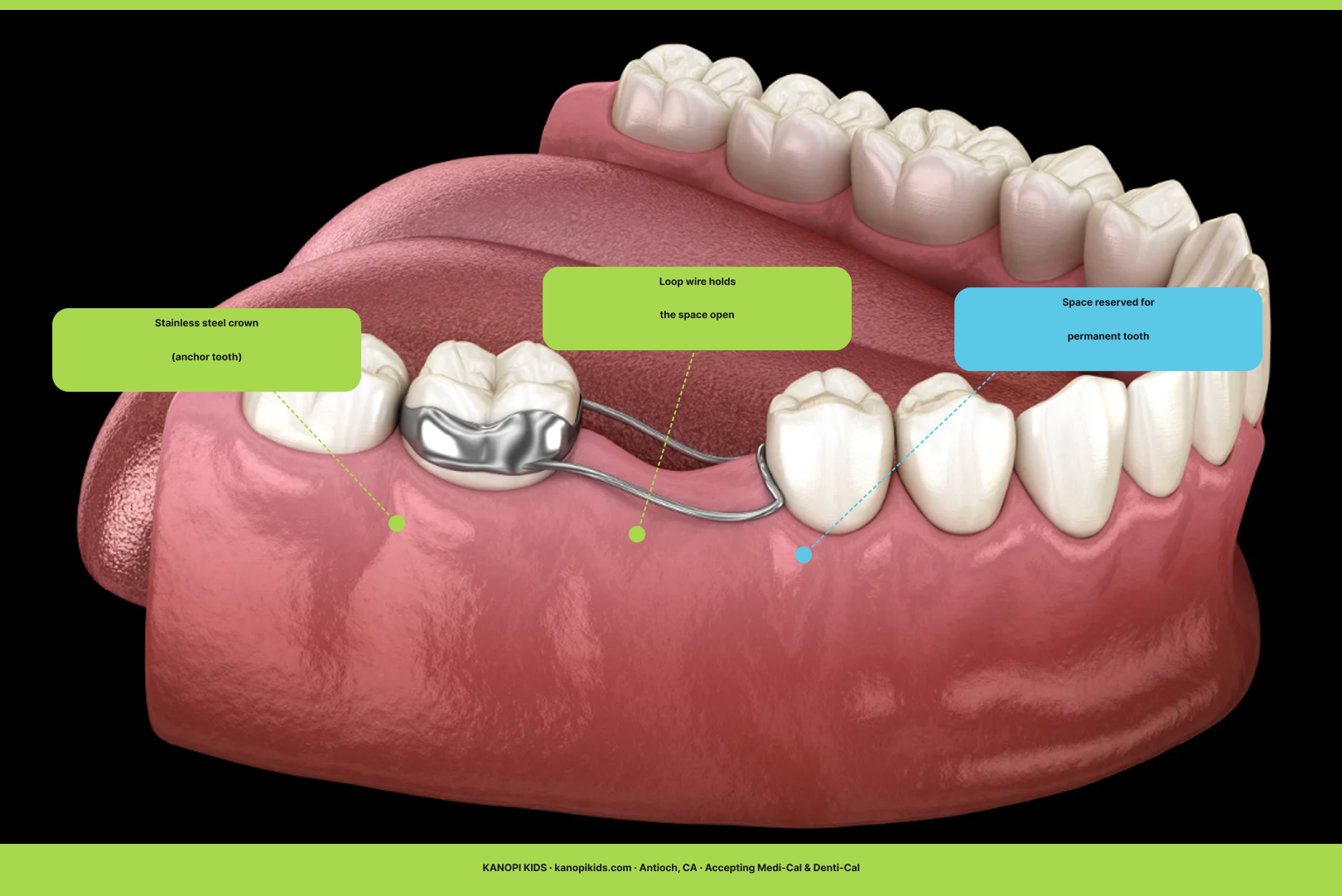
A space maintainer is a small custom-made dental appliance that holds the gap left by a missing baby tooth. It is attached to the teeth on either side of the space and prevents them from drifting while the jaw and permanent teeth continue developing. Space maintainers are typically made from stainless steel wire and in some cases include a small metal crown on the anchor tooth.
They are not braces and they do not move teeth. Their only job is to keep existing teeth in place so the permanent tooth has a clear path to erupt when the time comes. Most children adjust to a space maintainer within a few days and find it comfortable to eat and speak with normally.
Band and loop: the most common type for a single missing tooth. A metal band wraps around the anchor tooth next to the gap, and a wire loop extends across the space to hold it open. This is thet ype shown in the illustration on this page.
Distal shoe: used when a back molar is lost before the permanent molar has erupted. A small metal extension guides the permanent molar into the correct position as it comes in.
Lingual holding arch: used when multiple teeth are missing on the lower jaw. A wire runs along the inside of the lower teeth to maintain space on both sides.
Nance appliance: similar to the lingual holding arch but used on the upper jaw. It connects to the upper molars with a wire and an acrylic pad that rests against the roof of the mouth.
Not always. Whether a space maintainer is recommended depends on which tooth was lost, how old the child is, and how close the permanent tooth is to erupting. If X-rays show that the permanent tooth is already very close to the surface and expected to come in within a few months, a space maintainer may not be necessary. On the other hand, if a molar is lost several years before the permanent tooth is due, the risk of shifting is significant and a maintainer is almost always recommended.
This is exactly why the evaluation matters. Our team in Antioch looks at the full picture, including your child's age, the specific tooth involved, and the panoramic X-ray showing what is happening below the gumline, before making any recommendation.
What to Expect After a Space Maintainer Is Placed
Placement is a straightforward appointment that typically takes less than an hour. The area is numbed if a band needs to be fitted around an anchor tooth, and the appliance is cemented into place. Most children feel mild pressure for a day or two but no significant discomfort.
Caring for a space maintainer at home
The space maintainer is removed once the permanent tooth has erupted enough to hold the space on its own. This is a quick and simple appointment with no discomfort.
Preventing unnecessary crowding early is one of the most effective ways to reduce the complexity and cost of orthodontic treatment later. Many children who receive a space maintainer after early tooth loss need shorter or simpler orthodontic treatment during their teen years compared to children whose spaces were left unmanaged. In some cases, managing the space correctly means avoiding braces altogether.
At Kanopi Kids we offer both pediatric dentistry and orthodontics in our Antioch office, which means the same team overseeing your child's space maintainer is also tracking their overall bite and jaw development. If orthodontic treatment becomes appropriate down the road, the transition is seamless. You can learn more about our orthodontic services on our pediatric orthodontics page.
Space maintainers can be placed as soon as a baby tooth is lost prematurely, which can happen as young as 2 or 3 years old. There is no minimum age. The decision is based on which tooth was lost and how the surrounding teeth and jaw are developing, not the child's age alone.
The placement appointment is not painful. The area is numbed before any bands are fitted, and the appliance is cemented in place without any drilling or removal of tooth structure. Most children feel mild pressure or awareness of the appliance for the first day or two, which resolves on its own.
It depends entirely on how close the permanent tooth is to erupting when the baby tooth is lost. Some children wear a space maintainer for six months, others for two to three years. The appliance is checked at every routine visit and removed as soon as the permanent tooth has erupted enough to maintain the space naturally.
Without a space maintainer, the teeth next to the gap will often drift into the empty space within weeks or months. This can block the permanent tooth from erupting correctly, cause crowding, and create bite problems that may require more extensive orthodontic treatment to correct later. It is much simpler and less expensive to prevent the shifting than to correct it after it has happened.
Yes, space maintainers are generally a covered benefit under Medi-Cal and Denti-Cal for children who meet the clinical criteria. At Kanopi Kids in Antioch we accept both Medi-Cal and Denti-Cal, and our team can verify your child's coverage before the appointment so there are no surprises.
Kanopi Kids Pediatric Dentistry | Antioch, CA
Serving Antioch, Brentwood, Oakley, Pittsburg, Discovery Bay, Bay Point, and surrounding Contra Costa County. We accept Medi-Cal, Denti-Cal, and most major insurance plans.
kanopikids.com | 3110 Buchanan Rd, Suite B, Antioch, CA | (925) 281-4893
 (925) 281-4893(925) 281-4893(925) 281-4893(925) 281-4893(925) 281-4893(925) 281-4893